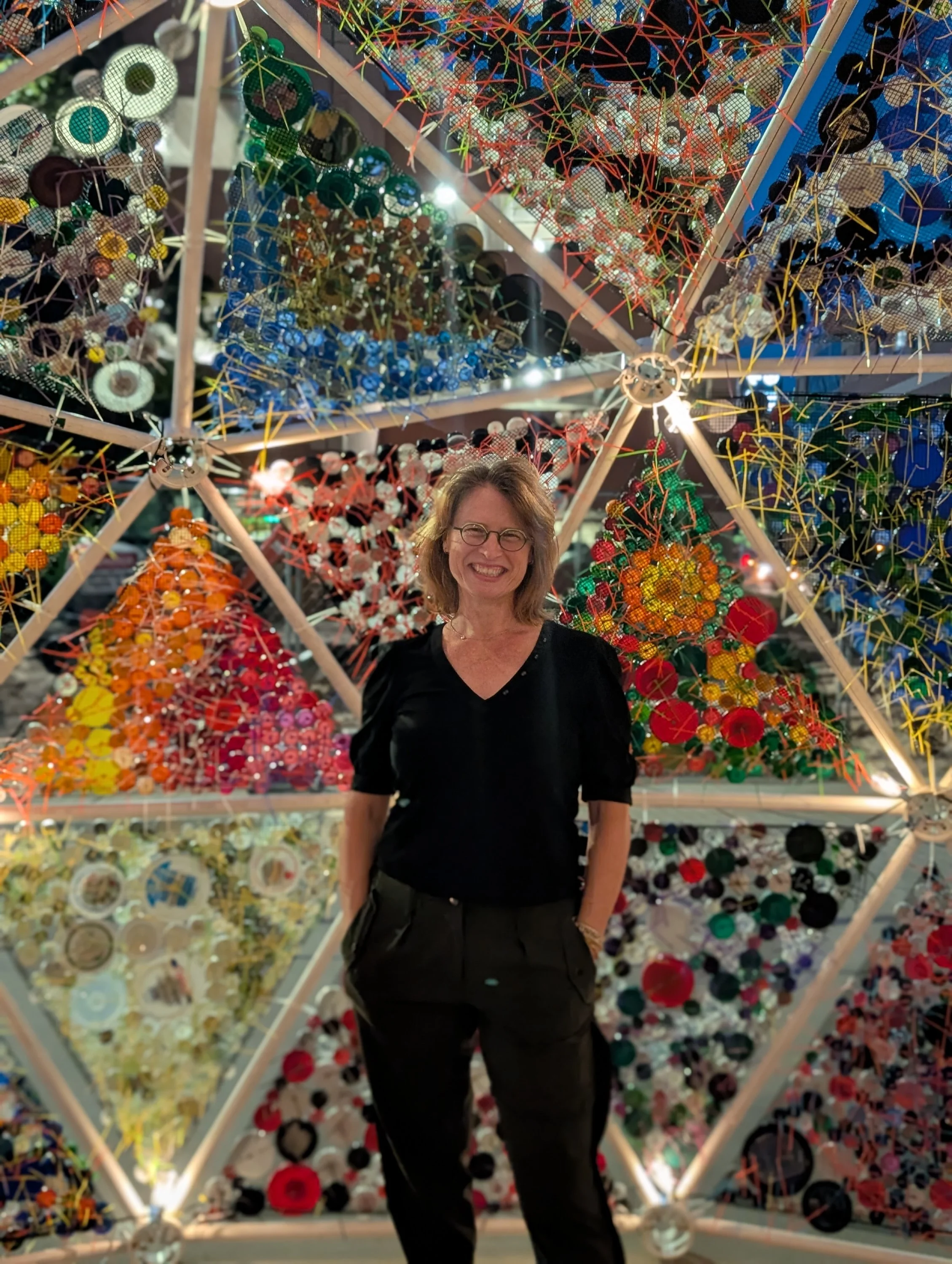
Artist Bio
Adrienne Outlaw's sculptures investigate relational ecologies by examining how material, spatial, and social relationships shape collective life. For Outlaw, sculpture is uniquely capable of making these connections physically perceptible. Movement through and around her sculptures allows the body to encounter these relationships before the mind interprets them, allowing meaning to emerge through experience.
Working primarily with discarded materials imbued with history and memory, Outlaw approaches familiar objects as sites of inquiry into value, trust, and care. Through accumulation, transformation, suspension, and assembly, her sculptures reveal how individual elements become systems and how those systems shape collective life. The histories embedded in these materials serve as a lens through which she investigates trust, revealing the gap between apparent and actual support.
Her public sculpture creates relational ecologies in which people practice interdependence by balancing care for themselves, one another, and the Earth. Through her national artist-led initiative, Make Waves, she partners with river cities to create large-scale temporary sculptural environments constructed from community-collected post-consumer plastic. These installations transform the spaces they inhabit into places where people naturally gather, linger, and experience the work together. Joy, curiosity, and shared purpose become sculptural conditions through which people rehearse different ways of being together. Through that shared experience, ecological stewardship becomes a lived practice of balancing care for ourselves, one another, and the Earth.
Her studio practice investigates the structures and systems that shape collective life, asking viewers to reconsider which ones actually sustain us and which merely appear to. Together, her studio and public practices investigate the conditions through which trust, responsibility, and care are formed, experienced, and sustained.
Outlaw's work has been commissioned and collected by the U.S. Embassy in Abuja, Cheekwood Estate & Gardens, the Tennessee State Museum, Vanderbilt University, Washington University School of Medicine, and St. Louis Lambert International Airport. Her work has been featured in Art in America, Hyperallergic, Sculpture Magazine, and other publications. She has received support from the National Endowment for the Arts and the Andy Warhol Foundation for the Visual Arts and was recognized through Creative Capital's On Our Radar program.